Word Association Sort: Puzzle
- 4.7
- Rating
- 50.00K
- Installs
- Free
- Price
 Analysis by App-foxy
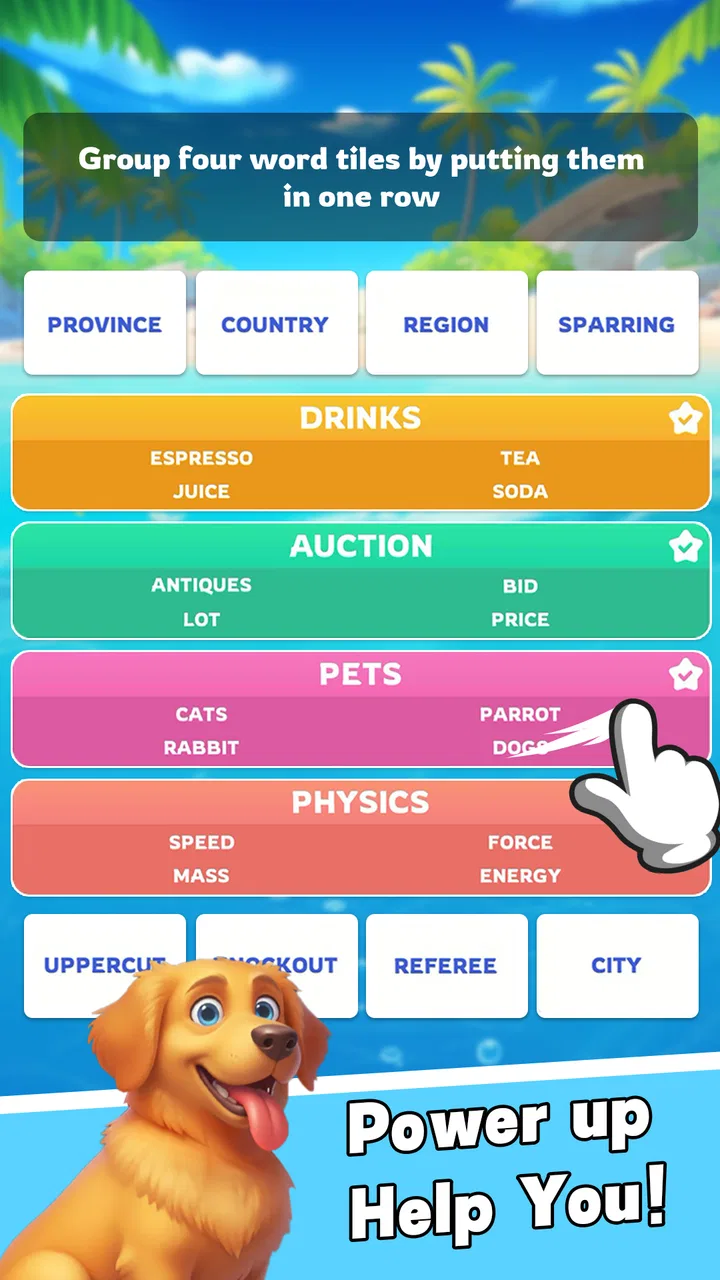
I found Word Association Sort: Puzzle most interesting when I stopped treating it like a simple vocabulary test. Its central idea is easy to understand: four words need to be sorted into related groups, and the challenge comes from noticing which connection is intended rather than merely possible. That small distinction creates most of the fun, but it also explains why some rounds feel instantly satisfying while others can leave me staring at the screen.
This is a free word game from Hippo Lab, aimed at Everyone and available for devices running Android 7.0 or later. The game has built a strong early audience, with an average rating of 4.8 from around 1K ratings and over 50K installs. Those figures suggest that its compact puzzle format is appealing, but they do not remove the need to understand what kind of player will actually enjoy it.
Where I got stuck and why the puzzle design matters
My first mistake was looking for the most obvious relationship between words. In a round like this, several terms can appear connected by topic, spelling, usage, or cultural association. The intended grouping is usually narrower. A word may fit two possible sets, while another word quietly reveals the stronger pattern. I learned to avoid locking in the first attractive combination and instead inspect all four words together.
You May Also Like

 Blood Strike: 2.5 Anniversary
Blood Strike’s Loadouts Turn Every Drop Into a Tactical Gamble
A close look at Blood Strike’s custom loadouts: how fast access to signature weapons reshapes its battle royale rhythm, rewards preparation, and narrows the gap between fights.

 Pandora - Music & Podcasts
Pandora’s Music Is Easy to Start, but Harder to Recover
Pandora’s strength is its low-effort path from a seed to a station. Its weak spot is how much confidence it asks you to place in connection, setup, and quiet recovery.

 8 Ball Pool
 Is Built on Rivalries, Rematches, and Routine
A close look at the rivalries, rematches, shared routines, and unanswered safety questions that turn a quick pool match into a persistent mobile community.

 Samsung Music
’s Quiet Strength Is Playing What You Already Own
Its reach comes less from spectacle than from dependable access to a personal library. That simplicity is both the app’s strongest retention engine and its ceiling.

 AccuWeather: Weather Radar
AccuWeather Review: A Quick, Clear Forecast for Everyday Decisions
For everyday plans, the best forecast is the one you can understand quickly. AccuWeather makes rain timing, radar, and local conditions easy to act on, with a few trade-offs.

 Hill Climb Racing
Why Hill Climb Racing Still Turns Crashes Into One More Run
A tiny car, a bumpy hill and one more upgrade: Hill Climb Racing keeps resurfacing because its simple chaos makes every near-miss feel personal.
More From Our News Desk
View All News


That makes the game feel less like ordinary guessing and more like a process of elimination. When I found one convincing pair, I did not immediately treat it as progress. I asked whether the remaining words formed a cleaner group and whether the original pair belonged somewhere else. This habit is especially useful when a category is based on a less direct relationship. The game rewards patience more than fast tapping.
The pet interaction gives the experience a softer tone than a strictly competitive word puzzle. I see it as a small reason to return between rounds rather than the main attraction. Players looking for a deep virtual-pet simulation will probably find the interaction too light, while people who enjoy a little personality around their puzzles may appreciate the change of pace.
One practical friction point is that the game’s simplicity can make a difficult round feel ambiguous. In a large crossword, crossing letters help confirm an answer. Here, the player has fewer external clues, so a category that feels slightly broad can become the deciding factor. I found it useful to read each word literally before reaching for an unusual interpretation. A clever connection is not automatically the intended one.
How I approached a stubborn group
When I was stuck, I divided the words into three mental types: words that clearly belonged together, words with multiple possible homes, and the one that seemed unrelated. The last word was often more useful than the apparent pair because it exposed the category I had overlooked. This is a simple technique, but it prevents the common mistake of spending too long defending a weak theory.
Another helpful approach was to identify the category before selecting every member. If two words looked like names, actions, objects, or references, I tried to describe the relationship in one plain phrase. If I could not explain the category without using vague language such as “they are kind of related,” I treated the group as provisional. That small test made my choices more deliberate.
I also avoided making several guesses in rapid succession. The value of the game is in examining the structure, and hurried taps can turn a solvable round into a frustrating one. A short pause to rearrange the possibilities is usually more productive than repeatedly choosing the same combination. This is one of the better ways to play during a brief break without letting the puzzle become irritating.
Setup checks before blaming the game
Getting started should be straightforward because this is a focused puzzle rather than a large, feature-heavy game. I would begin by checking that the device meets the Android requirement and that the installation has completed normally. If the game behaves strangely immediately after installation, closing it completely and reopening it is a sensible first step before assuming the puzzle itself is broken.
The current version is 2.6.2, so keeping the installed version current is also a reasonable check when something does not behave as expected. I would use the normal app-store update process rather than searching for unofficial installation files. That keeps the setup simple and avoids introducing a separate problem while trying to solve the first one.
Because the game is free, the initial decision is easy for a curious player: there is no purchase required to try the basic experience. The listing also includes in-app purchases ranging from $0.99 to $29.99 per item. I would therefore review the device’s purchase controls before handing the phone to a child, even though the content rating is Everyone. The age rating describes the content, not how a device handles purchases.
For a family setup, I would also make sure the person playing understands what tapping a purchase control may do. This is not a criticism of the word gameplay; it is simply good practice for any free game that offers optional paid items. If you want a completely purchase-free environment, device-level restrictions are more dependable than relying on memory during a quick puzzle session.
Another useful setup check is expectation. The store presents it as word association and sorting, not as a full language course, a story adventure, or a conventional crossword. I would not install it expecting definitions, long-form clues, or a campaign with elaborate progression. Its appeal is the short act of finding categories, with the pet element adding a little warmth around that central loop.
Choosing the right player and playing situation
I think it works best for someone who enjoys pattern recognition and can tolerate a little uncertainty. It suits a commute, a waiting room, or a short evening session because a single puzzle can be considered without preparing a large game world. It is also a reasonable choice for friends or family members who like discussing why words belong together. Saying the possible category aloud often reveals whether the connection is solid.
It is less suitable for players who need constant action, a strong narrative, or a clearly measurable competitive goal. Someone who prefers timed challenges may find the relaxed sorting format too quiet. Likewise, a player who dislikes wordplay based on broad associations may consider some rounds unfair even when the intended grouping is eventually understandable.
A realistic everyday use is a ten-minute break after work. I might open the game expecting to solve one round, sort the words, interact briefly with the pet, and put the phone away. If I get stuck, I can leave the puzzle rather than losing a long run of progress. That makes it less demanding than many strategy games, although the absence of pressure also means it may not hold the attention of someone seeking a more intense session.
Recovering a workflow after a wrong guess
A wrong selection does not have to end the session. My recovery method is to rebuild the round from scratch instead of trying to patch the previous idea. I separate the words mentally, write down the strongest connection in my head, and then test what remains. This avoids the sunk-cost trap where I keep forcing one attractive category simply because I already spent time on it.
I found it useful to distinguish between a category and a theme. A theme is broad: several words may relate to travel, food, or entertainment. A category should be more precise. It might describe how the words are used, what they name, or what they share linguistically. When my explanation sounded like a general topic rather than a specific relationship, I usually needed to look again.
For players who share a device, taking a screenshot or noting the four words before asking someone else can make collaboration more useful. Instead of handing over the phone and accepting a random tap, I can ask, “What is the narrowest connection between these?” That turns the puzzle into a small conversation and reduces the chance that another person simply guesses without explaining the reasoning.
If the game seems to stop responding after an input, I would first wait briefly, then close and reopen it. I would avoid repeatedly tapping the same area, since that can make it harder to tell whether the original action registered. If the issue returns, checking for an available update and restarting the device are sensible general steps. These actions do not solve every possible technical issue, but they are safe ways to separate a temporary hiccup from a repeatable problem.
I would also avoid clearing app storage as a first response. That can remove local state in some apps, and it is unnecessary when the problem may only be a temporary display or input issue. A restart and an update check are less disruptive. If the same failure continues, recording exactly what happened—where it occurred and whether it repeats—will make any later support request more useful.
Why the free model changes how I use it
The free entry point makes experimentation comfortable. I can try a few rounds without deciding whether the game deserves a budget. At the same time, optional purchases mean I would not describe it as a completely purchase-free product. The sensible approach is to enjoy the sorting loop first and treat any paid item as optional rather than assuming it is necessary for the game to make sense.
This is also where the game differs from a traditional printed puzzle book. A book gives me a fixed collection of puzzles with no purchase prompts once it is owned, while this app is easier to carry and more convenient for a spontaneous round. A dedicated crossword or word-search app may offer a broader range of formats, but it will not necessarily provide the same compact category-solving rhythm or the pet-centered presentation.
Compared with a daily word game, this one feels less dependent on a single daily appointment. That is useful when I want several short attempts or when my schedule is irregular. The trade-off is that a daily format often creates a stronger shared ritual and a clearer sense of completion. Here, the motivation comes more from the next interesting grouping than from a public daily milestone.
When the app is not the cause
Not every frustrating session points to a technical problem. Sometimes the real issue is fatigue. Word association depends on attention, and a category that looks impossible late at night may become obvious after a break. Before reinstalling anything, I would try stepping away for a few minutes and returning with a fresh view. That is especially worthwhile when the words seem familiar but the relationship between them feels blurred.
Screen size and input conditions can matter too. On a small phone, closely placed words may be harder to inspect at a glance, particularly for someone who prefers larger text or needs more visual space. If selecting a word feels unreliable, I would check whether the problem occurs across the whole screen or only in one area. A general touch issue belongs to the device or operating system, not necessarily to this game.
Distractions can also make the puzzle appear worse than it is. If I am switching between messages, music controls, and the game, I am more likely to miss a subtle connection or tap too quickly. A quiet, uninterrupted minute gives the sorting mechanic a fairer test. This is a small game, but its challenge is concentrated; divided attention has a noticeable effect.
Players should also consider language comfort. Association puzzles depend on nuance, double meanings, and familiar usage. Someone playing in a language they are still learning may find a round difficult for linguistic reasons rather than because the category is poorly designed. In that situation, a dictionary or language-learning tool may be a better companion, while this game remains more enjoyable as a casual exercise for readers already comfortable with the vocabulary.
Finally, expectations about hints can create disappointment. I would not approach every difficult round assuming that the game should immediately explain the answer in the way a tutorial might. The satisfaction comes from finding the relationship, so some uncertainty is part of the format. If I want a puzzle that always provides a visible path through clues, a crossword with crossing letters or a guided quiz may be a better fit.
My practical verdict after using the sorting loop
I see this as a pleasant, focused word game rather than an all-purpose brain-training package. Hippo Lab keeps the core idea easy to understand, but the four-word structure gives it enough room for misdirection and discovery. The pet interaction makes the presentation friendlier without changing the fact that the main reason to stay is the category-solving itself.
I would recommend it to players who like compact word puzzles, enjoy explaining connections, and want something that can be opened for a short session. It is particularly appealing if you prefer thoughtful taps over timers and do not need a story or elaborate progression to make a game worthwhile. The Everyone rating also makes it approachable for a broad audience, though adults should still handle purchase safeguards when children use the device.
I would skip it if your ideal word game is a serious crossword, a competitive spelling challenge, or a richly structured language-learning course. It may also disappoint anyone who dislikes ambiguous associations or expects every answer to be supported by an obvious clue. In those cases, a more formal puzzle format will probably feel fairer and more satisfying.
My final advice is to play slowly, describe categories precisely, and treat a wrong guess as information rather than failure. Check the Android requirement, keep the app updated, and use ordinary restart steps before assuming something is seriously wrong. With those expectations in place, Word Association Sort: Puzzle is an easy free download to try, with enough clever word grouping to earn a place in my short-break game rotation.
FAQs for Word Association Sort: Puzzle
01What is Word Association Sort: Puzzle and how does it work?
Word Association Sort: Puzzle is a brain-teasing game that challenges players to sort and connect words based on their associations. The objective is to find connections and pair words that relate to each other. With a variety of levels, players must use their vocabulary and cognitive skills to progress, making it an engaging and educational experience.
02Is Word Association Sort: Puzzle suitable for all age groups?
Yes, Word Association Sort: Puzzle is designed to be accessible and entertaining for players of all ages. The game provides a great way to enhance vocabulary and critical thinking skills. However, younger players might need assistance with more complex word associations. The game’s simple interface ensures it is easy to navigate for everyone.
03Does Word Association Sort: Puzzle require an internet connection to play?
No, Word Association Sort: Puzzle can be played offline, making it a convenient option for those who want to enjoy the game without an internet connection. However, some features, such as updates or leaderboard access, might require connectivity. This offline capability makes it perfect for travel or areas with limited internet access.
04Are there in-app purchases in Word Association Sort: Puzzle?
Yes, Word Association Sort: Puzzle offers in-app purchases. Players can buy hints or additional content to enhance their gaming experience. While the base game is free, these optional purchases can help players progress more easily through challenging levels. It is important to ensure that in-app purchases are managed to prevent unintended spending.
05How often does Word Association Sort: Puzzle receive updates?
Word Association Sort: Puzzle regularly receives updates to improve gameplay, add new levels, and fix any bugs. These updates are designed to keep the game fresh and engaging for players. Users are encouraged to keep the app updated for the best experience, including access to the latest features and improvements.
Pros
- Engaging and challenging puzzles.
- Simple and intuitive interface.
- Variety of levels and themes.
- Regular updates with new content.
- Offline play available.
Cons
- Limited hints for difficult levels.
- In-app purchases can be pricey.
- Ads can be intrusive at times.
- No multiplayer mode.
- Requires internet for updates.

Word Association Sort: Puzzle
Gallery